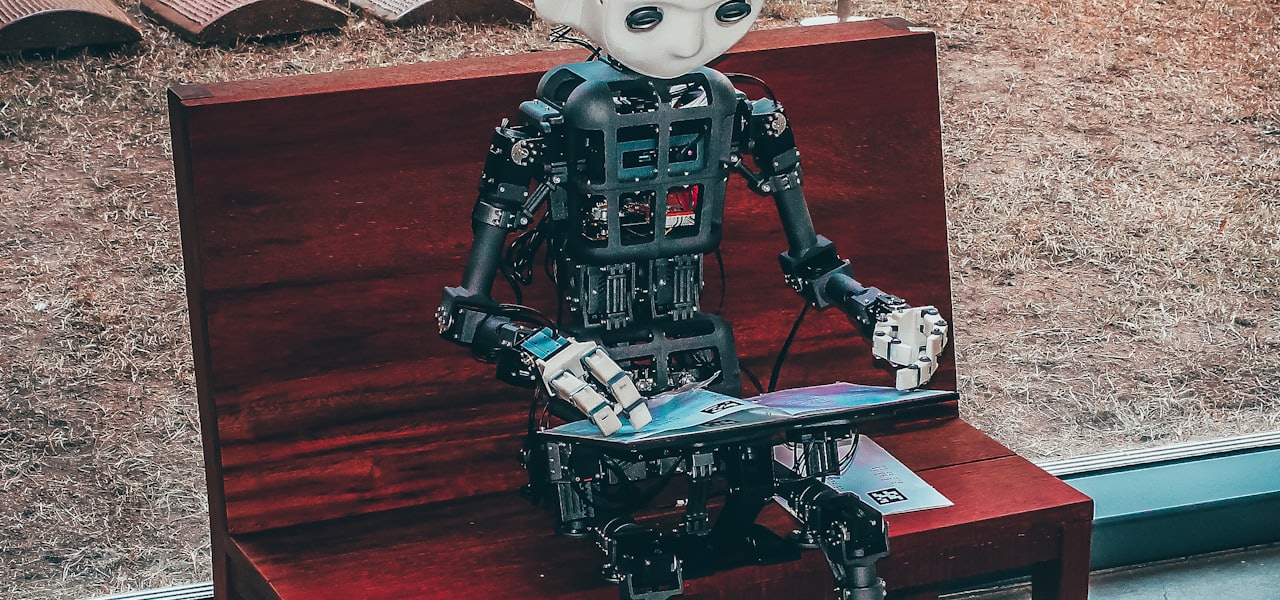
A Gödel machine is a hypothetical self-improving computer program that solves problems in an optimal way. It uses a recursive self-improvement protocol in which it rewrites its own code when it can prove the new code provides a better strategy. The machine was invented by Jürgen Schmidhuber (first proposed in 2003), but is named after Kurt Gödel who inspired the mathematical theories. The Gödel machine is often discussed when dealing with issues of meta-learning, also known as "learning to learn." Applications include automating human design decisions and transfer of knowledge between multiple related tasks, and may lead to design of more robust and general learning architectures. Though theoretically possible, no full implementation has been created. The Gödel machine is often compared with Marcus Hutter's AIXI, another formal specification for an artificial general intelligence. Schmidhuber points out that the Gödel machine could start out by implementing AIXItl as its initial sub-program, and self-modify after it finds proof that another algorithm for its search code will be better. == Limitations == Traditional problems solved by a computer only require one input and provide some output. Computers of this sort had their initial algorithm hardwired. This does not take into account the dynamic natural environment, and thus was a goal for the Gödel machine to overcome. The Gödel machine has limitations of its own, however. According to Gödel's First Incompleteness Theorem, any formal system that encompasses arithmetic is either flawed or allows for statements that cannot be proved in the system. Hence even a Gödel machine with unlimited computational resources must ignore those self-improvements whose effectiveness it cannot prove. == Variables of interest == There are three variables that are particularly useful in the run time of the Gödel machine. At some time t {\displaystyle t} , the variable time {\displaystyle {\text{time}}} will have the binary equivalent of t {\displaystyle t} . This is incremented steadily throughout the run time of the machine. Any input meant for the Gödel machine from the natural environment is stored in variable x {\displaystyle x} . It is likely the case that x {\displaystyle x} will hold different values for different values of variable time {\displaystyle {\text{time}}} . The outputs of the Gödel machine are stored in variable y {\displaystyle y} , where y ( t ) {\displaystyle y(t)} would be the output bit-string at some time t {\displaystyle t} . At any given time t {\displaystyle t} , where ( 1 ≤ t ≤ T ) {\displaystyle (1\leq t\leq T)} , the goal is to maximize future success or utility. A typical utility function follows the pattern u ( s , E n v ) : S × E → R {\displaystyle u(s,\mathrm {Env} ):S\times E\rightarrow \mathbb {R} } : u ( s , E n v ) = E μ [ ∑ τ = time T r ( τ ) ∣ s , E n v ] {\displaystyle u(s,\mathrm {Env} )=E_{\mu }{\Bigg [}\sum _{\tau ={\text{time}}}^{T}r(\tau )\mid s,\mathrm {Env} {\Bigg ]}} where r ( t ) {\displaystyle r(t)} is a real-valued reward input (encoded within s ( t ) {\displaystyle s(t)} ) at time t {\displaystyle t} , E μ [ ⋅ ∣ ⋅ ] {\displaystyle E_{\mu }[\cdot \mid \cdot ]} denotes the conditional expectation operator with respect to some possibly unknown distribution μ {\displaystyle \mu } from a set M {\displaystyle M} of possible distributions ( M {\displaystyle M} reflects whatever is known about the possibly probabilistic reactions of the environment), and the above-mentioned time = time ( s ) {\displaystyle {\text{time}}=\operatorname {time} (s)} is a function of state s {\displaystyle s} which uniquely identifies the current cycle. Note that we take into account the possibility of extending the expected lifespan through appropriate actions. == Instructions used by proof techniques == The nature of the six proof-modifying instructions below makes it impossible to insert an incorrect theorem into proof, thus trivializing proof verification. === get-axiom(n) === Appends the n-th axiom as a theorem to the current theorem sequence. Below is the initial axiom scheme: Hardware Axioms formally specify how components of the machine could change from one cycle to the next. Reward Axioms define the computational cost of hardware instruction and the physical cost of output actions. Related Axioms also define the lifetime of the Gödel machine as scalar quantities representing all rewards/costs. Environment Axioms restrict the way new inputs x are produced from the environment, based on previous sequences of inputs y. Uncertainty Axioms/String Manipulation Axioms are standard axioms for arithmetic, calculus, probability theory, and string manipulation that allow for the construction of proofs related to future variable values within the Gödel machine. Initial State Axioms contain information about how to reconstruct parts or all of the initial state. Utility Axioms describe the overall goal in the form of utility function u. === apply-rule(k, m, n) === Takes in the index k of an inference rule (such as Modus tollens, Modus ponens), and attempts to apply it to the two previously proved theorems m and n. The resulting theorem is then added to the proof. === delete-theorem(m) === Deletes the theorem stored at index m in the current proof. This helps to mitigate storage constraints caused by redundant and unnecessary theorems. Deleted theorems can no longer be referenced by the above apply-rule function. === set-switchprog(m, n) === Replaces switchprog S pm:n, provided it is a non-empty substring of S p. === check() === Verifies whether the goal of the proof search has been reached. A target theorem states that given the current axiomatized utility function u (Item 1f), the utility of a switch from p to the current switchprog would be higher than the utility of continuing the execution of p (which would keep searching for alternative switchprogs). === state2theorem(m, n) === Takes in two arguments, m and n, and attempts to convert the contents of Sm:n into a theorem. == Example applications == === Time-limited NP-hard optimization === The initial input to the Gödel machine is the representation of a connected graph with a large number of nodes linked by edges of various lengths. Within given time T it should find a cyclic path connecting all nodes. The only real-valued reward will occur at time T. It equals 1 divided by the length of the best path found so far (0 if none was found). There are no other inputs. The by-product of maximizing expected reward is to find the shortest path findable within the limited time, given the initial bias. === Fast theorem proving === Prove or disprove as quickly as possible that all even integers > 2 are the sum of two primes (Goldbach’s conjecture). The reward is 1/t, where t is the time required to produce and verify the first such proof. === Maximizing expected reward with bounded resources === A cognitive robot that needs at least 1 liter of gasoline per hour interacts with a partially unknown environment, trying to find hidden, limited gasoline depots to occasionally refuel its tank. It is rewarded in proportion to its lifetime, and dies after at most 100 years or as soon as its tank is empty or it falls off a cliff, and so on. The probabilistic environmental reactions are initially unknown but assumed to be sampled from the axiomatized Speed Prior, according to which hard-to-compute environmental reactions are unlikely. This permits a computable strategy for making near-optimal predictions. One by-product of maximizing expected reward is to maximize expected lifetime.
List of robotics journals
List of robotics journals includes notable academic and scientific journals that focus on research in the field of robotics and automation. == Journals == Acta Mechanica et Automatica Advanced Robotics Annual Review of Control, Robotics, and Autonomous Systems IEEE Robotics and Automation Letters IEEE Transactions on Robotics IEEE Transactions on Field Robotics The International Journal of Advanced Manufacturing Technology International Journal of Humanoid Robotics International Journal of Robotics Research Journal of Cognitive Engineering and Decision Making Journal of Field Robotics Journal of Intelligent & Robotic Systems Paladyn Robotics and Autonomous Systems Robotics Science Robotics SLAS Technology
Botler AI
Botler AI is a Montreal-based Canadian Artificial Intelligence company that helps users navigate the legal system. Launched in 2017 by Amir Morv and Ritika Dutt, Botler offers a free online tool which provides users who are unaware of their legal rights with information and guidance. Botler is known for its role in unveiling misconduct in the Government of Canada's procurement practices. Botler's findings have prompted numerous investigations, including by the Royal Canadian Mounted Police. == History == Botler's first AI was trained on over 300,000 U.S. and Canadian legal documents to help individuals identify and enforce their legal rights, without fear of judgment. Launched during the height of the #MeToo movement, the tool initially focused on sexual harassment with a goal of creating "a general artificial intelligence that would help the average person with any legal issue." === Department of Justice Canada === In 2020, Botler launched an expanded misconduct detection system in the form of an anonymous chatbot which provided users with an explanation of the law and relevant resources. In March 2021, the Minister of Justice and Attorney General of Canada announced the Government of Canada's support for Botler AI to assist complainants of sexual harassment in the workplace. The initiative, entitled Botler for Citizens and implemented with the support of the Department of Justice Canada, established an Artificial Intelligence-powered hybrid legal service delivery model. == Notable cases == On October 4, 2023, the RCMP confirmed to The Globe and Mail that they "are investigating a file referred from the CBSA (Canada Border Services Agency) that is based on allegations brought to their attention by Botler". In 2019, GCStrategies's managing partner, Kristian Firth, reached out to Botler on behalf of his client, the CBSA, to solicit their misconduct detection chatbot. After interactions with GCStrategies, Dalian Enterprises and Coradix Technology Consulting, the three main contractors involved in developing the controversial ArriveCAN app, Dutt and Morv alerted the CBSA to questionable contracting practices in federal government procurement in September, 2021, and again in November, 2022. In response to Botler's November 2022 report, the CBSA launched an internal review and referred the matter to the RCMP. During testimony before a parliamentary committee, the CBSA's President stated that the CBSA investigation to date has raised some concerns and shows "that there was a pattern of persistent collaboration between certain officials and GCStrategies... to circumvent or ignore certain established processes and roles and responsibilities". The Auditor General of Canada, which extended its study into ArriveCAN following the Botler revelations, found that GCStrategies was directly involved in setting narrow terms for a request for proposal for a $25-million government contract it ultimately won. The firm, which has just two employees, charges the government a commission of between 15 per cent and 30 per cent of each contract's value. The Office of the Procurement Ombudsman of Canada found "numerous examples" where GCStrategies "had simply copied and pasted" the required work experience to meet contracting requirements. To date, more than a dozen probes have been launched into the matter, including by the government, parliamentary committees, independent watchdogs and law-enforcement agencies. On April 17, 2024, GCStrategies' Firth was the first person summoned in over a century to answer questions before Members of Parliament in the House of Commons. During his appearance, Firth testified that the RCMP had raided "my property to obtain electronic goods surrounding the Botler allegations". === Government of Canada Reforms === One day after The Globe reported that the RCMP is investigating allegations of misconduct, the federal government responded by announcing new guidelines from the Treasury Board of Canada aimed at cutting back on the use of private consultants and that outsourcing contracts were under examination. Public Services and Procurement Canada (PSPC) invalidated and replaced all master level user agreements with government client departments in November 2023. The agreements set out the conditions for access to select Professional Services methods of supply which are used for outsourcing. In March 2024, PSPC announced its suspension of the respective security statuses of GCStrategies, Dalian and Coradix, barring them from participating in all federal procurements. Records show that the total value of contracts awarded to the three companies amounts to more than $1 Billion.
Anthropic–United States Department of Defense dispute
Since January 2026, the United States Department of Defense has conflicted with the artificial intelligence company Anthropic over the use of its products for military purposes and mass domestic surveillance. == Background == === Artificial intelligence in the U.S. military === The United States Department of Defense began developing lethal autonomous weapons as early as the Reagan administration. The Department of Defense established a policy on the use of artificial intelligence in 2012, Directive 3000.09. Efforts to utilize artificial intelligence intensified under the term of secretary Ash Carter. The Department of Defense's use of artificial intelligence for Project Maven prompted concerns within Google in 2018, leading to protests and mass resignations. === Anthropic in the second Trump administration === In Donald Trump's second presidency, Anthropic publicly disagreed with the administration's policies and initiatives. In January 2025, Anthropic chief executive Dario Amodei criticized the artificial intelligence investment project Stargate as "chaotic" and opposed Trump's rescission of president Joe Biden's Executive Order on Artificial Intelligence, but noted that Anthropic had held discussions with Trump officials about artificial intelligence policy. Amid discussions over the One Big Beautiful Bill Act, Anthropic privately lobbied for Congress to vote against a bill preventing states from regulating artificial intelligence and expressed opposition to an artificial intelligence agreement signed among Gulf states in Trump's visit to the Middle East in May. According to Semafor, Trump officials chastised Anthropic's hiring of several officials involved in the Biden administration, including Elizabeth Kelly, the former director of the Artificial Intelligence Safety Institute; Tarun Chhabra, the coordinator for technology and national security in the National Security Council; and Ben Buchanan, Biden's advisor for artificial intelligence. The following month, Amodei wrote an op-ed in The New York Times describing the artificial intelligence regulation bill, then tied to the One Big Beautiful Bill Act, as "far too blunt an instrument". Prior to the dispute, the Trump administration had integrated Anthropic's services. By November 2024, Anthropic had already partnered with Palantir and Amazon Web Services, companies that offered services with FedRAMP authorization. In the Biden administration, Anthropic had reached an agreement with the AI Safety Institute and had participated in a nuclear information safety evaluation. The Department of Homeland Security authorized its workers to use commercial artificial intelligence systems, including Anthropic's Claude, until May 2025. Through its interoperability with Palantir, a company heavily involved in data analysis and analytics at the Department of Defense, Anthropic's technology achieved relatively widespread usage in the U.S. military. The following month, Anthropic announced that it would allow national security customers to use Claude Gov. Anthropic's orthogonal usage policy to the surveillance systems implemented at the Federal Bureau of Investigation, the Secret Service, and Immigration and Customs Enforcement led to a conflict between Anthropic and the Trump administration by September. That month, Amodei criticized Trump's approach to export restrictions on semiconductors. Anthropic's strategy has mirrored Amodei's views towards Trump; in a Facebook post ahead of the 2024 presidential election, Amodei urged his associates to vote for vice president Kamala Harris over Trump, describing him as a "feudal warlord". As the Trump administration targeted law firms, Amodei cut ties with the firms Skadden, Arps, Slate, Meagher & Flom and Latham & Watkins, which reached agreements with the Trump administration to avoid punishment. David Sacks, Trump's advisor for artificial intelligence and cryptocurrency, said on All-In (2020–present) that Anthropic was among several "AI doomers" that support regulation he saw as overly restrictive. According to The Wall Street Journal, officials close to Sacks examined whether Anthropic's Claude was a "woke AI"; in July, Trump signed an executive order "Preventing Woke AI in the Federal Government ". Sacks viewed Amodei's decision to attend the World Economic Forum over Trump's second inauguration; his hiring of Biden officials; and Anthropic's association with the philanthropic initiative Open Philanthropy as evidence that Anthropic would not support Trump's agenda. In October 2025, Sacks stated that Anthropic was "running a sophisticated regulatory capture strategy based on fear-mongering." That month, Amodei published a blog post rebuffing "inaccurate claims" from the Trump administration on Anthropic's policies, intensifying the dispute. Amodei's statement included views explicitly espoused by vice president JD Vance. In December, Amodei met with Trump officials and several senators in an effort to improve Anthropic's relationship with the Trump administration. == Dispute == In December 2025, secretary of defense Pete Hegseth announced GenAI.mil, an artificial intelligence platform for the Department of Defense. The department initially contracted Google Gemini for the platform, then OpenAI's ChatGPT. The following month, Hegseth announced that the Department of Defense would additionally contract xAI's Grok for use in the military, decrying "woke AI." In January 2026, Semafor reported that the Department of Defense had conflicted with Anthropic over its policies on lethal military force and that Hegseth's comment on woke AI was a reference to Anthropic. According to Reuters, Anthropic representatives opposed the use of the company's products for surveillance or to develop lethal autonomous weapons. The dispute between Anthropic and the Department of Defense resulted in the termination of a contract worth an estimated US$200 million. In February 2026, Emil Michael, the under secretary of defense for research and engineering, stated that the Department of Defense would expand access to commercial artificial intelligence systems, including Anthropic's Claude, to unclassified and classified domains. That month, Axios reported that the Department of Defense had used Claude in the United States intervention in Venezuela. Anthropic told Axios that it would reassess its partnership with the Department of Defense after the revelations. After Anthropic refused to agree to allow the Department of Defense to use Claude for "all lawful purposes," the department threatened to cancel its contracts with the company. Hegseth additionally moved to label Anthropic a "supply chain risk," which would have forced military contractors to cut ties with Anthropic. A federal judge blocked this designation, describing it as punitive. Michael told reporters that Anthropic should "cross the Rubicon" and allow the Department of Defense to dictate the terms of how its technology is used. The position of the Department of Defense, and its tactics during the dispute, were widely criticized on grounds including violating the principles of rule-of-law, market independence and national security. == Impact == The dispute caused 1789 Capital, a venture capital firm associated with Donald Trump Jr., to abandon an investment in Anthropic worth hundreds of millions of dollars. Following the government's actions against Anthropic, OpenAI "rushed", hours before the US started the 2026 Iran war, to get a deal without the constraints that Anthropic had sought. == Lawsuits == In March 2026, Judge Rita F. Lin granted a preliminary injunction against the government. Lin wrote: The Department of War’s records show that it designated Anthropic as a supply chain risk because of its “hostile manner through the press.” Punishing Anthropic for bringing public scrutiny to the government’s contracting position is classic illegal First Amendment retaliation. (...) At bottom, Anthropic has shown that these broad punitive measures were likely unlawful and that it is suffering irreparable harm from them. Numerous amici have also described wide-ranging harm to the public interest, including the chilling of open discussion about important topics in AI safety. In April 2026, the Court of Appeals for the D.C. Circuit in a per curiam order denied Anthropic's motion to lift the designation. The April order is not final. The court's order said lifting the designation "would force the United States military to prolong its dealings with an unwanted vendor of critical AI services in the middle of a significant ongoing military conflict". According to Wired, "Several experts in government contracting and corporate rights" said "Anthropic has a strong case against the government, but the courts sometimes refuse to overrule the White House on matters related to national security."
Semantic network
A semantic network, or frame network is a knowledge base that represents semantic relations between concepts in a network. This is often used as a form of knowledge representation. It is a directed or undirected graph consisting of vertices, which represent concepts, and edges, which represent semantic relations between concepts, mapping or connecting semantic fields. A semantic network may be instantiated as, for example, a graph database or a concept map. Typical standardized semantic networks are expressed as semantic triples. Semantic networks are used in natural language processing applications such as semantic parsing and word-sense disambiguation. Semantic networks can also be used as a method to analyze large texts and identify the main themes and topics (e.g., of social media posts), to reveal biases (e.g., in news coverage), or even to map an entire research field. == History == Examples of the use of semantic networks in logic, directed acyclic graphs as a mnemonic tool, dates back centuries. The earliest documented use being the Greek philosopher Porphyry's commentary on Aristotle's categories in the third century AD. In computing history, "Semantic Nets" for the propositional calculus were first implemented for computers by Richard H. Richens of the Cambridge Language Research Unit in 1956 as an "interlingua" for machine translation of natural languages. Although the importance of this work and the CLRU was only belatedly realized. Semantic networks were also independently implemented by Robert F. Simmons and Sheldon Klein, using the first order predicate calculus as a base, after being inspired by a demonstration of Victor Yngve. The "line of research was originated by the first President of the Association [Association for Computational Linguistics], Victor Yngve, who in 1960 had published descriptions of algorithms for using a phrase structure grammar to generate syntactically well-formed nonsense sentences. Sheldon Klein and I about 1962-1964 were fascinated by the technique and generalized it to a method for controlling the sense of what was generated by respecting the semantic dependencies of words as they occurred in text." Other researchers, most notably M. Ross Quillian and others at System Development Corporation helped contribute to their work in the early 1960s as part of the SYNTHEX project. It's from these publications at SDC that most modern derivatives of the term "semantic network" cite as their background. Later prominent works were done by Allan M. Collins and Quillian (e.g., Collins and Quillian; Collins and Loftus Quillian). Still later in 2006, Hermann Helbig fully described MultiNet. In the late 1980s, two Netherlands universities, Groningen and Twente, jointly began a project called Knowledge Graphs, which are semantic networks but with the added constraint that edges are restricted to be from a limited set of possible relations, to facilitate algebras on the graph. In the subsequent decades, the distinction between semantic networks and knowledge graphs was blurred. In 2012, Google gave their knowledge graph the name Knowledge Graph. The Semantic Link Network was systematically studied as a social semantics networking method. Its basic model consists of semantic nodes, semantic links between nodes, and a semantic space that defines the semantics of nodes and links and reasoning rules on semantic links. The systematic theory and model was published in 2004. This research direction can trace to the definition of inheritance rules for efficient model retrieval in 1998 and the Active Document Framework ADF. Since 2003, research has developed toward social semantic networking. This work is a systematic innovation at the age of the World Wide Web and global social networking rather than an application or simple extension of the Semantic Net (Network). Its purpose and scope are different from that of the Semantic Net (or network). The rules for reasoning and evolution and automatic discovery of implicit links play an important role in the Semantic Link Network. Recently it has been developed to support Cyber-Physical-Social Intelligence. It was used for creating a general summarization method. The self-organised Semantic Link Network was integrated with a multi-dimensional category space to form a semantic space to support advanced applications with multi-dimensional abstractions and self-organised semantic links It has been verified that Semantic Link Network play an important role in understanding and representation through text summarisation applications. Semantic Link Network has been extended from cyberspace to cyber-physical-social space. Competition relation and symbiosis relation as well as their roles in evolving society were studied in the emerging topic: Cyber-Physical-Social Intelligence More specialized forms of semantic networks has been created for specific use. For example, in 2008, Fawsy Bendeck's PhD thesis formalized the Semantic Similarity Network (SSN) that contains specialized relationships and propagation algorithms to simplify the semantic similarity representation and calculations. == Basics of semantic networks == A semantic network is used when one has knowledge that is best understood as a set of concepts that are related to one another. Most semantic networks are cognitively based. They also consist of arcs and nodes which can be organized into a taxonomic hierarchy. Semantic networks contributed ideas of spreading activation, inheritance, and nodes as proto-objects. == Examples == === In Lisp === The following code shows an example of a semantic network in the Lisp programming language using an association list. To extract all the information about the "canary" type, one would use the assoc function with a key of "canary". === WordNet === An example of a semantic network is WordNet, a lexical database of English. It groups English words into sets of synonyms called synsets, provides short, general definitions, and records the various semantic relations between these synonym sets. Some of the most common semantic relations defined are meronymy (A is a meronym of B if A is part of B), holonymy (B is a holonym of A if B contains A), hyponymy (or troponymy) (A is subordinate of B; A is kind of B), hypernymy (A is superordinate of B), synonymy (A denotes the same as B) and antonymy (A denotes the opposite of B). WordNet properties have been studied from a network theory perspective and compared to other semantic networks created from Roget's Thesaurus and word association tasks. From this perspective the three of them are a small world structure. === Other examples === It is also possible to represent logical descriptions using semantic networks such as the existential graphs of Charles Sanders Peirce or the related conceptual graphs of John F. Sowa. These have expressive power equal to or exceeding standard first-order predicate logic. Unlike WordNet or other lexical or browsing networks, semantic networks using these representations can be used for reliable automated logical deduction. Some automated reasoners exploit the graph-theoretic features of the networks during processing. Other examples of semantic networks are Gellish models. Gellish English with its Gellish English dictionary, is a formal language that is defined as a network of relations between concepts and names of concepts. Gellish English is a formal subset of natural English, just as Gellish Dutch is a formal subset of Dutch, whereas multiple languages share the same concepts. Other Gellish networks consist of knowledge models and information models that are expressed in the Gellish language. A Gellish network is a network of (binary) relations between things. Each relation in the network is an expression of a fact that is classified by a relation type. Each relation type itself is a concept that is defined in the Gellish language dictionary. Each related thing is either a concept or an individual thing that is classified by a concept. The definitions of concepts are created in the form of definition models (definition networks) that together form a Gellish Dictionary. A Gellish network can be documented in a Gellish database and is computer interpretable. SciCrunch is a collaboratively edited knowledge base for scientific resources. It provides unambiguous identifiers (Research Resource IDentifiers or RRIDs) for software, lab tools etc. and it also provides options to create links between RRIDs and from communities. Another example of semantic networks, based on category theory, is ologs. Here each type is an object, representing a set of things, and each arrow is a morphism, representing a function. Commutative diagrams also are prescribed to constrain the semantics. In the social sciences people sometimes use the term semantic network to refer to co-occurrence networks. == Software tools == There are also elaborate types of semantic networks connected with corresponding sets of software tools used for
AI literacy
AI literacy or artificial intelligence literacy is "a set of competencies that enables individuals to critically evaluate AI technologies; communicate and collaborate effectively with AI; and use AI as a tool online, at home, and in the workplace." AI is employed in a variety of applications, including self-driving automobiles, virtual assistants and text generation by generative AI models. Users of these tools should be able to make informed decisions. AI literacy may have an impact on students' future employment prospects. With the rise of generative AI platforms, AI literacy has become a topic of conversation in the field of education. Some think AI literacy is essential for school and college students, while others restrict or prohibit the use of AI in assignments, viewing it as a form of academic dishonesty. However, many researchers and educational institutions promote a more nuanced approach, encouraging critical engagement with AI while developing policies that balance academic integrity with opportunities for learning. == Definitions == Other definitions of AI literacy include the ability to understand, use, monitor, and critically reflect on AI applications. That use of the term usually refers to teaching skills and knowledge to the general public, particularly those who are not adept in AI and the ability to understand, use, evaluate, and ethically navigate AI. As research into AI literacy is still emerging and focused on developing context-specific skills, there is not yet a single, broadly agreed-upon definition. AI literacy is linked to other forms of literacy. AI literacy requires digital literacy, whereas scientific and computational literacy may inform it. Data literacy also significantly overlaps with it. == Categories == AI literacy encompasses multiple categories, including a theoretical understanding of how artificial intelligence works, the usage of artificial intelligence technologies, and the critical appraisal of artificial intelligence, and its ethics. === Know and understand AI === Knowledge and understanding of AI refers to a basic understanding of what artificial intelligence is and how it works. This includes familiarity with machine learning algorithms and the limitations and biases present in AI systems. Users who know and understand AI should be familiar with various technologies that use artificial intelligence, including cognitive systems, robotics and machine learning. This includes recognizing that large language models (LLMs) are machine learning models trained on extensive datasets which generate new text rather than retrieving pre-written responses. === Use and apply AI === Using and applying AI refers to the ability to use AI tools to solve problems and perform tasks such as programming and analyzing big data. Some consider prompt engineering, the practice of designing effective prompts to guide generative AI platforms more effectively, as another competency within AI literacy. === Evaluate and create AI === Evaluation and creation refers to the ability to critically evaluate the quality and reliability of AI systems. It also refers to designing and building fair and ethical AI systems. To evaluate correctly, users should also learn in which areas AI is strong, and in which areas it is weak. === AI ethics === AI ethics refers to understanding the moral implications of AI, and the making informed decisions regarding the use of AI tools. This area includes considerations such as: Accountability: Hold AI actors accountable for the operation of AI systems and adherence to ethical ideals. Accuracy: Identify and report sources of error and uncertainty in algorithms and data. Auditability: Enable other parties to audit and assess algorithm behavior via transparent information sharing. Explainability: Make sure that algorithmic judgments and the underlying data can be presented in simple language. Fairness: Prevent biases and consider varied viewpoints. To do so, increase the diversity of researchers in the field. Human Centricity and Well-being: Prioritize human well-being in AI development and deployment. Human rights Alignment: Ensure that technology do not infringe internationally recognized human rights. Inclusivity: Make AI accessible to everyone. Progress: Choose high value initiatives. Responsibility, accountability, and transparency: Foster trust via responsibility, accountability, and fairness. Robustness and Security: Make AI systems safe, secure, and resistant to manipulation or data breach. Sustainability: Choose implementations that generate long-term, useful benefits. Environmental Implications: How this tool impacts the environment, any restrictions or laws, if this impact is worth the effects or not. === Enabling AI === Support AI by developing associated knowledge and skills such as programming and statistics. == Promoting AI literacy == Several governments have recognized the need to promote AI literacy, including among adults. Such programs have been published in the United States, China, Germany and Finland. Programs intended for the general public usually consist of short and easy to understand online study units. Programs intended for children are usually project-based. Programs for students at colleges and universities often address the specific professional needs of the student, depending on their field of study. Beyond the education system, AI literacy can also be developed in the community, for example in museums. === Schools === Schools use diverse pedagogies to promote AI literacy. These include: Performing a Turing test with an intelligent agent Creating chatbots Building apps using Blockly-based programming Project-based learning Building robots Data visualization Training AI models Artificial intelligence curricula can improve students' understanding of topics such as machine learning, neural networks, and deep learning. === Higher education === Before the second decade of the 21st century, artificial intelligence was studied mainly in STEM courses. Later, projects emerged to increase artificial intelligence education, specifically to promote AI literacy. Most courses start with one or more study units that deal with basic questions such as what artificial intelligence is, where it comes from, what it can do and what it can't do. Most courses also refer to machine learning and deep learning. Some of the courses deal with moral issues in artificial intelligence. In Ireland, the Higher Education Authority published Generative AI in Higher Education Teaching & Learning: Policy Framework in December 2025, which encouraged higher education institutions to embed AI literacy across programmes as a core graduate attribute. ==== Disciplinary policy ==== As a response to the increase of generative AI use in education, several disciplines formed committees or task forces to examine context-specific approaches toward AI literacy. In spring 2025, the Modern Language Association and Conference on College Composition and Communication Joint Task Force finished development of three working papers, a guide on AI literacy for students, and a collection of resources addressing AI use in writing. The task force emphasized the need for "a culture of critical AI literacy" and included guidelines not only for students but also educators and institutions, highlighting the need for modeling ethical AI use in planning processes. Similarly, a committee formed by the American Historical Association Council published "Guiding Principles for Artificial Intelligence in History Education" which encouraged "clear and transparent engagement with generative AI." The guidelines demonstrate the value of criticality when working with generative AI in thinking and research.
Fei-Fei Li
Fei-Fei Li (Chinese: 李飞飞; pinyin: Lǐ Fēifēi; born July 3, 1976) is a Chinese-born American computer scientist best known for establishing ImageNet, the dataset that enabled rapid advances in computer vision in the 2010s. She is a professor of computer science at Stanford University, with research expertise in artificial intelligence, machine learning, deep learning, computer vision, and cognitive neuroscience. Li is a co-director of the Stanford Institute for Human-Centered Artificial Intelligence and a co-director of the Stanford Vision and Learning Lab, and served as Chief Scientist of AI/ML at Google Cloud and the director of the Stanford Artificial Intelligence Laboratory from 2013 to 2018. In 2017, she co-founded AI4ALL, a nonprofit organization working to increase diversity in the field of artificial intelligence. In 2023, Li was named one of the Time 100 AI Most Influential People. Li received the Intel Lifetime Achievements Innovation Award in 2017 for her contributions to artificial intelligence, and was elected member of the National Academy of Engineering, the National Academy of Medicine in 2020 and the American Academy of Arts and Sciences in 2021. In 2025, she was named as one of the "Architects of AI" for Time's Person of the Year. On August 3, 2023, Li was appointed to the United Nations Scientific Advisory Board, established by Secretary-General Antonio Guterres. In 2024, Li was included on the Gold House's most influential Asian A100 list. In 2024, she raised $230 million for a startup called World Labs, which she and three colleagues founded to develop a "spatial intelligence" AI technology that can understand how the three-dimensional physical world works. In 2026, World Labs raised $1 Billion. == Early life and education == Li was born in Beijing, China, in 1976 and grew up in Chengdu, Sichuan. She studied at Sichuan Chengdu No.7 High School. When she was 12, her father immigrated to Parsippany, New Jersey. When she was 16, Li and her mother joined him in the United States. While attending Parsippany High School, Li worked weekends at her family's dry-cleaning shop. She graduated from Parsippany High School in 1995. She was inducted into the hall of fame at Parsippany High School in 2017. Li pursued undergraduate study at Princeton University, where she received a Bachelor of Arts with a major in physics in 1999. Li completed her senior thesis, "Auditory binaural correlogram difference: a new computational model for Huggins dichotic pitch", under the supervision of Bradley Dickinson, professor of electrical engineering. During her years at Princeton, Li returned home most weekends to help run her family's dry cleaning business and worked as a dishwasher to supplement the family income. Li pursued graduate study at the California Institute of Technology, where she received a Master of Science in electrical engineering in 2001 and a Doctor of Philosophy in electrical engineering in 2005. Li completed her dissertation, "Visual Recognition: Computational Models and Human Psychophysics", under the primary supervision of Pietro Perona and secondary supervision of Christof Koch. Her graduate studies were supported by the National Science Foundation Graduate Research Fellowship and The Paul & Daisy Soros Fellowships for New Americans. == Career and research == From 2005 to 2006, Li was an assistant professor in the Electrical and Computer Engineering Department at the University of Illinois Urbana-Champaign, and from 2007 to 2009, she was an assistant professor in the Computer Science Department at Princeton University. She joined Stanford in 2009 as an assistant professor, and was promoted to associate professor with tenure in 2012, and then full professor in 2018. At Stanford, Li served as the director of Stanford Artificial Intelligence Lab (SAIL) from 2013 to 2018. Her research has focused on computer vision, deep learning, and cognitive neuroscience, with over 300 peer-reviewed publications. She became the founding co-director of Stanford's University-level initiative - the Human-Centered AI Institute, along with co-director Dr. John Etchemendy, former provost of Stanford University. The institute aligns with Li's aims to advance AI research, education, policy, and practice to improve the human condition. While at Princeton in 2007, Li led the development of ImageNet, a massive visual database designed to advance object recognition in AI. The project involved labeling over 14 million images using Amazon Mechanical Turk and inspired the ImageNet Large Scale Visual Recognition Challenge (ILSVRC), which catalyzed progress in deep learning and led to dramatic improvements in image classification performance. The database addressed a key bottleneck in computer vision: the lack of large, annotated datasets for training machine learning models. Today, ImageNet is credited as a cornerstone innovation that underpins advancements in autonomous vehicles, facial recognition, and medical imaging. On her sabbatical from Stanford University from January 2017 to fall of 2018, Li joined Google Cloud as its Chief Scientist of AI/ML and Vice President. At Google, her team focused on democratizing AI technology and lowering the barrier for entrance to businesses and developers, including the developments of products like AutoML. In September 2017, Google secured a contract from the Department of Defense called Project Maven, which aimed to use AI techniques to interpret images captured by drone cameras. Google told employees who protested the company's work on Project Maven that their role was "specifically scoped to be for non-offensive purposes". In June 2018, Google told employees it would not seek renewal of the contract. In internal emails which were later leaked to reporters, Li expressed enthusiasm for the Google Cloud role in Project Maven, but warned against mentioning its AI component, saying that military AI is linked in the public mind with the danger of autonomous weapons. Asked about those leaked emails, Li told The New York Times, "I believe in human-centered AI to benefit people in positive and benevolent ways. It is deeply against my principles to work on any project that I think is to weaponize AI." In the fall of 2018, Li left Google and returned to Stanford University to continue her professorship. In 2023, Li co-led the launch of the RAISE-Health (Responsible AI for Safe and Equitable Health) initiative at Stanford University in collaboration with Stanford medicine. The initiative aims to develop frameworks for the responsible use of artificial intelligence in healthcare, including clinical care, biomedical research, and patient safety. According to her Stanford profile, she has been on partial academic leave from January 2024 through the end of 2025 to focus on entrepreneurial ventures. In 2024, Li said there was a disparity between private-sector investment in AI and support for academic and government research, and called for greater public funding for scientific uses of the technology and for studying its risks. Li is also known for her non-profit work as the co-founder and chairperson of nonprofit organization AI4ALL, whose mission is to educate the next generation of AI technologists, thinkers and leaders by promoting diversity and inclusion through human-centered AI principles. The program was created in collaboration with Melinda French Gates and Jensen Huang. Prior to establishing AI4ALL in 2017, Li and her former student Olga Russakovsky, currently an assistant professor in Princeton University, co-founded and co-directed the precursor program at Stanford called SAILORS (Stanford AI Lab OutReach Summers). SAILORS was an annual summer camp at Stanford dedicated to 9th grade high school girls in AI education and research, established in 2015 till it changed its name to AI4ALL @Stanford in 2017. In 2018, AI4ALL has successfully launched five more summer programs in addition to Stanford, including Princeton University, Carnegie Mellon University, Boston University, University of California Berkeley, and Canada's Simon Fraser University. We are at a turning point. AI's influence continues to grow, but representation and inclusion of a diversity of researchers in the field does not. It's critical that we seize this moment to create structures that will support long-term, positive changes. This won't happen via a single mechanism or quick fix. It starts with early education and extends to the existing structures of power within academia, work cultures among current AI researchers, and gatekeeping functions of research publishing, to name a few levers of change. Li has been described as a "researcher bringing humanity to AI". Li was elected as a member of the American Academy of Arts and Sciences in 2021, the National Academy of Engineering in 2020, and the National Academy of Medicine in 2020. In a November 2023 interview with The Guardian, Li said that while she would not refer to herself as the "godmother