In mathematics, the sieve of Pritchard is an algorithm for finding all prime numbers up to a specified bound. Like the ancient sieve of Eratosthenes, it has a simple conceptual basis in number theory. It is especially suited to quick hand computation for small bounds. Whereas the sieve of Eratosthenes marks off each non-prime for each of its prime factors, the sieve of Pritchard avoids considering almost all non-prime numbers by building progressively larger wheels, which represent the pattern of numbers not divisible by any of the primes processed thus far. It thereby achieves a better asymptotic complexity, and was the first sieve with a running time sublinear in the specified bound. Its asymptotic running-time has not been improved on, and it deletes fewer composites than any other known sieve. It was created in 1979 by Paul Pritchard. Since Pritchard has created a number of other sieve algorithms for finding prime numbers, the sieve of Pritchard is sometimes singled out by being called the wheel sieve (by Pritchard himself) or the dynamic wheel sieve. == Overview == A prime number is a natural number that has no natural number divisors other than the number 1 and itself. To find all the prime numbers less than or equal to a given integer N, a sieve algorithm examines a set of candidates in the range 2, 3, …, N, and eliminates those that are not prime, leaving the primes at the end. The sieve of Eratosthenes examines all of the range, first removing all multiples of the first prime 2, then of the next prime 3, and so on. The sieve of Pritchard instead examines a subset of the range consisting of numbers that occur on successive wheels, which represent the pattern of numbers left after each successive prime is processed by the sieve of Eratosthenes. For i > 0, the ith wheel Wi represents this pattern. It is the set of numbers between 1 and the product Pi = p1 · p2 ⋯ pi of the first i prime numbers that are not divisible by any of these prime numbers (and is said to have an associated length Pi). This is because adding Pi to a number does not change whether it is divisible by one of the first i prime numbers, since the remainder on division by any one of these primes is unchanged. So W1 = {1} with length P1 = 2 represents the pattern of odd numbers; W2 = {1,5} with length P2 = 6 represents the pattern of numbers not divisible by 2 or 3; etc. Wheels are so-called because Wi can be usefully visualized as a circle of circumference Pi with its members marked at their corresponding distances from an origin. Then rolling the wheel along the number line marks points corresponding to successive numbers not divisible by one of the first i prime numbers. The animation shows W2 being rolled up to 30. It is useful to define Wi → n for n > 0 to be the result of rolling Wi up to n. Then the animation generates W2 → 30 = {1,5,7,11,13,17,19,23,25,29}. Note that up to 52 − 1 = 24, this consists only of 1 and the primes between 5 and 25. The sieve of Pritchard is derived from the observation that this holds generally: for all i > 0, the values in Wi → (p2i+1 − 1) are 1 and the primes between pi+1 and p2i+1. It even holds for i = 0, where the wheel has length 1 and contains just 1 (representing all the natural numbers). So the sieve of Pritchard starts with the trivial wheel W0 and builds successive wheels until the square of the wheel's first member after 1 is at least N. Wheels grow very quickly, but only their values up to N are needed and generated. It remains to find a method for generating the next wheel. Note in the animation that W3 = {1,5,7,11,13,17,19,23,25,29} − {5 · 1 , 5 · 5} can be obtained by rolling W2 up to 30 and then removing 5 times each member of W2.This also holds generally: for all i ≥ 0, Wi+1 = (Wi → Pi+1) − {pi+1 · w | w ∈ Wi}. Rolling Wi past Pi just adds values to Wi, so the current wheel is first extended by getting each successive member starting with w = 1, adding Pi to it, and inserting the result in the set. Then the multiples of pi+1 are deleted. Care must be taken to avoid a number being deleted that itself needs to be multiplied by pi+1. The sieve of Pritchard as originally presented does so by first skipping past successive members until finding the maximum one needed, and then doing the deletions in reverse order by working back through the set. This is the method used in the first animation above. A simpler approach is just to gather the multiples of pi+1 in a list, and then delete them. Another approach is given by Gries and Misra. If the main loop terminates with a wheel whose length is less than N, it is extended up to N to generate the remaining primes. The algorithm, for finding all primes up to N, is therefore as follows: Start with a set W = {1} and length = 1 representing wheel 0, and prime p = 2. As long as p2 ≤ N, do the following: if length < N, then extend W by repeatedly getting successive members w of W starting with 1 and inserting length + w into W as long as it does not exceed p · length or N; increase length to the minimum of p · length and N. repeatedly delete p times each member of W by first finding the largest ≤ length and then working backwards. note the prime p, then set p to the next member of W after 1 (or 3 if p was 2). if length < N, then extend W to N by repeatedly getting successive members w of W starting with 1 and inserting length + w into W as long as it does not exceed N; On termination, the rest of the primes up to N are the members of W after 1. === Example === To find all the prime numbers less than or equal to 150, proceed as follows. Start with wheel 0 with length 1, representing all natural numbers 1, 2, 3...: 1 The first number after 1 for wheel 0 (when rolled) is 2; note it as a prime. Now form wheel 1 with length 2 × 1 = 2 by first extending wheel 0 up to 2 and then deleting 2 times each number in wheel 0, to get: 1 2 The first number after 1 for wheel 1 (when rolled) is 3; note it as a prime. Now form wheel 2 with length 3 × 2 = 6 by first extending wheel 1 up to 6 and then deleting 3 times each number in wheel 1, to get 1 2 3 5 The first number after 1 for wheel 2 is 5; note it as a prime. Now form wheel 3 with length 5 × 6 = 30 by first extending wheel 2 up to 30 and then deleting 5 times each number in wheel 2 (in reverse order), to get 1 2 3 5 7 11 13 17 19 23 25 29 The first number after 1 for wheel 3 is 7; note it as a prime. Now wheel 4 has length 7 × 30 = 210, so we only extend wheel 3 up to our limit 150. (No further extending will be done now that the limit has been reached.) We then delete 7 times each number in wheel 3 until we exceed our limit 150, to get the elements in wheel 4 up to 150: 1 2 3 5 7 11 13 17 19 23 25 29 31 37 41 43 47 49 53 59 61 67 71 73 77 79 83 89 91 97 101 103 107 109 113 119 121 127 131 133 137 139 143 149 The first number after 1 for this partial wheel 4 is 11; note it as a prime. Since we have finished with rolling, we delete 11 times each number in the partial wheel 4 until we exceed our limit 150, to get the elements in wheel 5 up to 150: 1 2 3 5 7 11 13 17 19 23 25 29 31 37 41 43 47 49 53 59 61 67 71 73 77 79 83 89 91 97 101 103 107 109 113 119 121 127 131 133 137 139 143 149 The first number after 1 for this partial wheel 5 is 13. Since 13 squared is at least our limit 150, we stop. The remaining numbers (other than 1) are the rest of the primes up to our limit 150. Just 8 composite numbers are removed, once each. The rest of the numbers considered (other than 1) are prime. In comparison, the natural version of Eratosthenes sieve (stopping at the same point) removes composite numbers 184 times. == Pseudocode == The sieve of Pritchard can be expressed in pseudocode, as follows: algorithm Sieve of Pritchard is input: an integer N >= 2. output: the set of prime numbers in {1,2,...,N}. let W and Pr be sets of integer values, and all other variables integer values. k, W, length, p, Pr := 1, {1}, 2, 3, {2}; {invariant: p = pk+1 and W = Wk ∩ {\displaystyle \cap } {1,2,...,N} and length = minimum of Pk,N and Pr = the primes up to pk} while p2 <= N do if (length < N) then Extend W,length to minimum of plength,N; Delete multiples of p from W; Insert p into Pr; k, p := k+1, next(W, 1) if (length < N) then Extend W,length to N; return Pr ∪ {\displaystyle \cup } W - {1}; where next(W, w) is the next value in the ordered set W after w. procedure Extend W,length to n is {in: W = Wk and length = Pk and n > length} {out: W = Wk → {\displaystyle \rightarrow } n and length = n} integer w, x; w, x := 1, length+1; while x <= n do Insert x into W; w := next(W,w); x := length + w; length := n; procedure Delete multiples of p from W,length is integer w; w := p; while pw <= length do w := next(W,w); while w > 1 do w := prev(W,w); Remove pw from W; where prev(W, w) is the previous value in the ordered set W before w. The algorithm can be initialized with W0 instead of W1 at the minor complication of making next(W, 1) a special case when k = 0. This a
Data cube
In computer programming, a data cube (or datacube) is a multi-dimensional array of values. Typically, the term "data cube" is applied in contexts where these arrays are massively larger than the hosting computer's main memory; examples include multi-terabyte/petabyte data warehouses and time series of image data. Even though it is called a cube, a data cube generally is a multi-dimensional concept which can be 1-dimensional, 2-dimensional, 3-dimensional, or higher-dimensional. The data cube is used to represent data (sometimes called facts) along some dimensions of interest. In satellite image timeseries, dimensions would be latitude and longitude coordinates and time; a fact (sometimes called measure) would be a pixel at a given space and time as taken by the satellite. For example, in online analytical processing, an OLAP cube about a company would have dimensions that could be the company subsidiaries, the company products, and time; in this setup, a fact would be a sales event where a particular product has been sold in a particular subsidiary at a particular time. In any case, every dimension divides data into groups of cells whereas each cell in the cube represents a single measure of interest. Sometimes cubes hold only a few values with the rest being empty, i.e. undefined, while sometimes most or all cube coordinates hold a cell value. In the first case such data are called sparse, and in the second case they are called dense, although there is no hard delineation between the two. Data cubes may be stored in database management systems (DBMS) as part of array DBMS. Spatio-temporal databases and geospatial databases may also be represented as coverage data. == History == Multi-dimensional arrays have long been familiar in programming languages. Fortran offers arbitrarily-indexed 1-D arrays and arrays of arrays, which allows the construction of higher-dimensional arrays, up to 15 dimensions. APL supports n-D arrays with a rich set of operations. All these have in common that arrays must fit into the main memory and are available only while the particular program maintaining them (such as image processing software) is running. A series of data exchange formats support storage and transmission of data cube-like data, often tailored towards particular application domains. Examples include MDX for statistical (in particular, business) data, Zarr and Hierarchical Data Format for general scientific data, and TIFF for imagery. In 1992, Peter Baumann introduced management of massive data cubes with high-level user functionality combined with an efficient software architecture. Datacube operations include subset extraction, processing, fusion, and in general queries in the spirit of data manipulation languages like SQL. Some years after, the data cube concept was applied to describe time-varying business data as data cubes by Jim Gray, et al., and by Venky Harinarayan, Anand Rajaraman and Jeff Ullman. Around that time, a working group on Multi-Dimensional Databases ("Arbeitskreis Multi-Dimensionale Datenbanken") was established at German Gesellschaft für Informatik. Datacube Inc. was an image processing company selling hardware and software applications for the PC market in 1996, however without addressing data cubes as such. The EarthServer initiative has established geo data cube service requirements. == Standardization == In 2018, the ISO SQL database language was extended with data cube functionality as "SQL – Part 15: Multi-dimensional arrays (SQL/MDA)". Web Coverage Processing Service is a geo data cube analytics language issued by the Open Geospatial Consortium in 2008. In addition to the common data cube operations, the language knows about the semantics of space and time and supports both regular and irregular grid data cubes, based on the concept of coverage data. An industry standard for querying business data cubes, originally developed by Microsoft, is MultiDimensional eXpressions. == Implementation == Many high-level computer languages treat data cubes and other large arrays as single entities distinct from their contents. These languages, of which Fortran, APL, IDL, NumPy, PDL, and S-Lang are examples, allow the programmer to manipulate complete film clips and other data en masse with simple expressions derived from linear algebra and vector mathematics. Some languages (such as PDL) distinguish between a list of images and a data cube, while many (such as IDL) do not. Array DBMSs (Database Management Systems) offer a data model which generically supports definition, management, retrieval, and manipulation of n-dimensional data cubes. This database category has been pioneered by the rasdaman system since 1994. == Applications == Multi-dimensional arrays can meaningfully represent spatio-temporal sensor, image, and simulation data, but also statistics data where the semantics of dimensions is not necessarily of spatial or temporal nature. Generally, any kind of axis can be combined with any other into a data cube. === Mathematics === In mathematics, a one-dimensional array corresponds to a vector, a two-dimensional array resembles a matrix; more generally, a tensor may be represented as an n-dimensional data cube. === Science and engineering === For a time sequence of color images, the array is generally four-dimensional, with the dimensions representing image X and Y coordinates, time, and RGB (or other color space) color plane. For example, the EarthServer initiative unites data centers from different continents offering 3-D x/y/t satellite image timeseries and 4-D x/y/z/t weather data for retrieval and server-side processing through the Open Geospatial Consortium WCPS geo data cube query language standard. A data cube is also used in the field of imaging spectroscopy, since a spectrally-resolved image is represented as a three-dimensional volume. Earth observation data cubes combine satellite imagery such as Landsat 8 and Sentinel-2 with Geographic information system analytics. === Business intelligence === In online analytical processing (OLAP), data cubes are a common arrangement of business data suitable for analysis from different perspectives through operations like slicing, dicing, pivoting, and aggregation.
Alec Radford
Alec Radford is an American artificial intelligence researcher. == Biography == Radford grew up in Texas. He graduated from Cistercian Preparatory School in 2011, where he became an Eagle Scout, and dropped out of Olin College in August 2014, where he and fellow students Slater Victoroff, Diana Yuan, and Madison May had formed the startup Indico in their dorm room. In 2015, the quartet were joined by Luke Metz and the firm and the Facebook AI research lab in New York used generative adversarial networks to create realistic low pixel images. A demonstration of Indico's technology was used without proper attribution in an April 2016 demonstration by Nvidia chief executive Jensen Huang. Radford joined OpenAI around 2016, where he worked on natural-language processing. The following year, Radford trained a neural network on Amazon reviews. The model was fairly basic, with layers which allowed for human understanding. Upon exploring it, he saw that it had a special neuron linked to the sentiment of the reviews, which it had created on its own. This was a drastic improvement from previous neural networks that had analysed sentiment, because they had to be told to do so and specially trained on data that was explicitly labeled according to sentiment. This development made OpenAI chief scientist Ilya Sutskever consider that a future model, using more diverse language data, could map far more structures of meaning, eventually becoming a "learned core module" for superintelligence. In 2018, Radford was the lead author on OpenAI's seminal research paper on generative pre-trained transformers, which form the foundation of ChatGPT. At OpenAI, he worked on early GPT models, Whisper, a speech recognition model, and the image generator DALL-E. He left OpenAI in December 2024 to pursue independent research. Around March 2025, Radford joined Thinking Machines Lab as an advisor. He joined along with Bob McGrew who was previously the chief research officer of OpenAI. In April 2026, Radford, Nick Levine, and David Duvenaud released Talkie, an AI model trained on books, newspapers, scientific journals, patents, and case law published before December 31, 1930. When asked about the state of the world in 2026, it stated that one billion people would live in Europe, that London and New York would be connected by steamships that transit between the two in ten days, and "winter will be passed in Paris, and the summer in London."
Shakey the robot
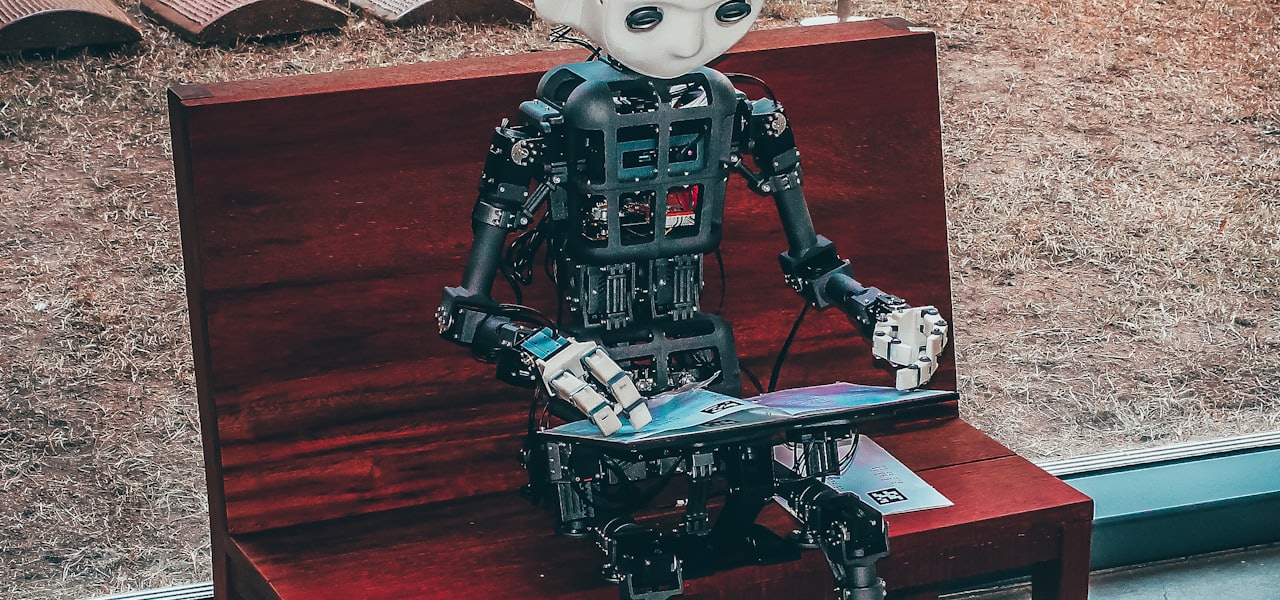
Shakey the Robot was the first general-purpose mobile robot able to reason about its own actions. While other robots would have to be instructed on each individual step of completing a larger task, Shakey could analyze commands and break them down into basic chunks by itself. Due to its nature, the project combined research in robotics, computer vision, and natural language processing. Because of this, it was the first project that melded logical reasoning and physical action. Shakey was developed at the Artificial Intelligence Center of Stanford Research Institute (now called SRI International). Some of the most notable results of the project include the A search algorithm, the Hough transform, and the visibility graph method. == History == Shakey was developed from approximately 1966 through 1972 with Charles Rosen, Nils Nilsson and Peter Hart as project managers. Other major contributors included Alfred Brain, Sven Wahlstrom, Bertram Raphael, Richard Duda, Richard Fikes, Thomas Garvey, Helen Chan Wolf and Michael Wilber. The project was funded by the Defense Advanced Research Projects Agency (DARPA) based on a SRI proposal submitted in April 1964 for research in "Intelligent Automata", later "Intelligent Automata to Reconnaissance". It was originally designed to have two retractable arms. Now retired from active duty, Shakey is currently on view in a glass display case at the Computer History Museum in Mountain View, California. The project inspired numerous other robotics projects, most notably the Centibots. == Software == The robot's programming was primarily done in LISP. The Stanford Research Institute Problem Solver (STRIPS) planner it used was conceived as the main planning component for the software it utilized. As the first robot that was a logical, goal-based agent, Shakey experienced a limited world. A version of Shakey's world could contain a number of rooms connected by corridors, with doors and light switches available for the robot to interact with. Shakey had a short list of available actions within its planner. These actions involved traveling from one location to another, turning the light switches on and off, opening and closing the doors, climbing up and down from rigid objects, and pushing movable objects around. The STRIPS automated planner could devise a plan to enact all the available actions, even though Shakey himself did not have the capability to execute all the actions within the plan personally. An example mission for Shakey might be something like, an operator types the command "push the block off the platform" at a computer console. Shakey looks around, identifies a platform with a block on it, and locates a ramp in order to reach the platform. Shakey then pushes the ramp over to the platform, rolls up the ramp onto the platform, and pushes the block off the platform. == Hardware == Physically, the robot was particularly tall, and had an antenna for a radio link, sonar range finders, a television camera, on-board processors, and collision detection sensors ("bump detectors"). The robot's tall stature and tendency to shake resulted in its name: We worked for a month trying to find a good name for it, ranging from Greek names to whatnot, and then one of us said, 'Hey, it shakes like hell and moves around, let’s just call it Shakey.' == Research results == The development of Shakey provided far-reaching impact on the fields of robotics and artificial intelligence, as well as computer science in general. Some of the more notable results include the development of the A search algorithm, which is widely used in pathfinding and graph traversal, the process of plotting an efficiently traversable path between points; the Hough transform, which is a feature extraction technique used in image analysis, computer vision, and digital image processing; and the visibility graph method for finding Euclidean shortest paths among obstacles in the plane. == Media and awards == In 1969 the SRI published "SHAKEY: Experimentation in Robot Learning and Planning", a 24-minute video. The project then received media attention. This included an article in the New York Times on April 10, 1969. In 1970, Life referred to Shakey as the "first electronic person"; and in November 1970 National Geographic Magazine covered Shakey and the future of computers. The Association for the Advancement of Artificial Intelligence's AI Video Competition's awards are named "Shakeys" because of the significant impact of the 1969 video. Shakey was inducted into Carnegie Mellon University's Robot Hall of Fame in 2004 alongside such notables as ASIMO and C-3PO. Shakey has been honored with an IEEE Milestone in Electrical Engineering and Computing. Shakey was showcased in the BBC's Towards Tomorrow: Robot (1967) documentary.
Thinking Machines Lab
Thinking Machines Lab Inc. is an American artificial intelligence (AI) startup founded by Mira Murati, the former chief technology officer of OpenAI. The company was founded in February 2025, and by July had completed an early-stage funding round led by Andreessen Horowitz, raising $2 billion at a valuation of $12 billion overall from investors such as Nvidia, AMD, Cisco, and Jane Street. The company is based in San Francisco and structured as a public benefit corporation. == History == By its launch in February 2025, Thinking Machines Lab was reported to have hired about 30 researchers and engineers from competitors including OpenAI, Meta AI, and Mistral AI. Its founding team members include Barret Zoph, former OpenAI VP of Research (Post-Training), Lilian Weng, former OpenAI VP, and OpenAI cofounder John Schulman, who joined after a brief stint at the lab's competitor Anthropic. In January 2026, it was reported that Barret Zoph and Luke Metz, departed the startup to return to OpenAI. Other former OpenAI employees who have been hired include Jonathan Lachman and Andrew Tulloch (although Tulloch departed after getting recruited for Meta Superintelligence Labs). Thinking Machines Lab's advisers include Bob McGrew, previously OpenAI's chief research officer, and Alec Radford, who was a lead researcher for OpenAI. On October 1, 2025, it announced Tinker, an API for fine-tuning language models. Users would submit jobs through the API for fine-tuning one of the various open-weight models supported. The Lab would run the jobs on its internal clusters and training infrastructure. == Business structure == Thinking Machines Lab grants Mira Murati a deciding vote on board matters, weighted to provide her with a majority decision-making capability. Additionally, founding shareholders possess votes weighted 100 times greater than those of regular shareholders. In July 2025, Andreessen Horowitz was reported to have led the company's initial funding round, raising "about $2 billion at a valuation of $12 billion". The government of Albania (Murati's country of origin) was also included in this round, making a $10 million investment which required an amendment to the country's 2025 budget. == Partnership == In March 2026, Thinking Machines Lab announced a strategic partnership with NVIDIA involving an undisclosed investment and a multi-year agreement to deploy one gigawatt of Vera Rubin computing capacity.
JSGF
JSGF stands for Java Speech Grammar Format or the JSpeech Grammar Format (in a W3C Note). Developed by Sun Microsystems, it is a textual representation of grammars for use in speech recognition for technologies like XHTML+Voice. JSGF adopts the style and conventions of the Java programming language in addition to use of traditional grammar notations. The Speech Recognition Grammar Specification was derived from this specification. == Example == The following JSGF grammar will recognize the words coffee, tea, and milk.
Elon Musk
Elon Reeve Musk ( EE-lon; born June 28, 1971) is a businessman and former public official known for his leadership of Tesla and SpaceX. Musk has been the wealthiest person in the world since 2025; as of June 2026, Forbes estimates his net worth to be US$834 billion. Born into the wealthy Musk family in Pretoria, South Africa, Musk emigrated in 1989 to Canada; he has Canadian citizenship since his mother was born there. He received bachelor's degrees in 1997 from the University of Pennsylvania before moving to California to pursue business ventures. In 1995, Musk co-founded the software company Zip2. Following its sale in 1999, he co-founded X.com, an online payment company that later merged to form PayPal, which was acquired by eBay in 2002. Musk also became an American citizen in 2002. In 2002, Musk founded the space technology company SpaceX, becoming its CEO and chief engineer; the company has since led innovations in reusable rockets and commercial spaceflight. Musk joined the automaker Tesla as an early investor in 2004 and became its CEO and product architect in 2008; it has since become a leader in electric vehicles. In 2015, he co-founded OpenAI to advance artificial intelligence (AI) research, but later left; growing discontent with the organization's direction and leadership in the AI boom in the 2020s led him to establish xAI, which became a subsidiary of SpaceX in 2026. In 2022, he acquired the social network Twitter, implementing significant changes, and rebranding it as X in 2023. His other businesses include the neurotechnology company Neuralink, which he co-founded in 2016, and the tunneling company the Boring Company, which he founded in 2017. In November 2025, Tesla approved a pay package worth $1 trillion for Musk, which he is to receive over 10 years if he meets specific goals. Musk is a supporter of global far-right politics, figures, and political parties. He was the largest donor in the 2024 U.S. presidential election, where he supported Donald Trump. After Trump was inaugurated as president in January 2025, Musk served as Senior Advisor to the President and as the de facto head of the Department of Government Efficiency (DOGE). Shortly before a public feud with Trump, Musk left the Trump administration in May 2025 and returned to managing his companies. Musk's political activities, statements and views have made him a polarizing figure. He has been criticized for making unscientific and misleading statements, including spreading COVID-19 misinformation, promoting conspiracy theories, and affirming antisemitic, racist, and transphobic comments. His acquisition of Twitter was controversial due to a subsequent increase in hate speech and the spread of misinformation on the service, following his pledge to decrease censorship. His role in the second Trump administration attracted public backlash, particularly in response to DOGE. == Early life and education == Elon Reeve Musk was born on June 28, 1971, in Pretoria, South Africa's administrative capital. He is of British and Pennsylvania Dutch ancestry. His mother, Maye (née Haldeman), is a model and dietitian born in Saskatchewan, Canada, and raised in South Africa. Musk therefore holds both South African and Canadian citizenship from birth. His father, Errol Musk, is a South African electromechanical engineer, pilot, sailor, consultant, emerald dealer, and property developer, who partly owned a rental lodge at Timbavati Private Nature Reserve. His maternal grandfather, Joshua N. Haldeman, who died in a plane crash when Elon was a toddler, was an American-born Canadian chiropractor, aviator and political activist in the Technocracy movement who moved to South Africa in 1950. Haldeman's anti-government, anti-democratic and conspiracist views, which included the promotion of far-right antisemitic conspiracy theories, "fanatical" support of apartheid, and according to Errol Musk, support of Nazism, have been suggested as an influence on Elon. During his childhood, Elon was told stories by his grandmother of Haldeman's travels and exploits, and Elon has suggested that all of Haldeman's descendants have his "desire for adventure, exploration – doing crazy things". Elon has a younger brother, Kimbal, a younger sister, Tosca, and four paternal half-siblings. Musk was baptized as a child in the Anglican Church of Southern Africa. The Musk family was wealthy during Elon's youth. Despite both Elon and Errol previously stating that Errol was a part owner of a Zambian emerald mine, in 2023, Errol recounted that the deal he made was to receive "a portion of the emeralds produced at three small mines". Errol was elected to the Pretoria City Council as a representative of the anti-apartheid Progressive Party and has said that his children shared their father's dislike of apartheid. After his parents divorced in 1979, Elon, aged around 9, chose to live with his father because he had an Encyclopædia Britannica set and a computer. Elon later regretted his decision and became estranged from his father. Elon has recounted trips to a wilderness school that he described as a "paramilitary Lord of the Flies" where "bullying was a virtue" and children were encouraged to fight over rations. In one incident, after an altercation with a fellow pupil, Elon was thrown down concrete steps and beaten severely, leading to him being hospitalized for his injuries. Elon described his father berating him after he was discharged from the hospital. Errol denied berating Elon and claimed, "The [other] boy had just lost his father to suicide, and Elon had called him stupid. Elon had a tendency to call people stupid. How could I possibly blame that child?" Elon was an enthusiastic reader of books, and had attributed his success in part to having read The Lord of the Rings, the Foundation series, and The Hitchhiker's Guide to the Galaxy. At age ten, he developed an interest in computing and video games, teaching himself how to program from the VIC-20 user manual. At age twelve, Elon sold his BASIC-based game Blastar to PC and Office Technology magazine for approximately $500 (equivalent to $1,600 in 2025). === Education === Musk attended Waterkloof House Preparatory School, Bryanston High School, and then Pretoria Boys High School, where he graduated. Musk was a decent but unexceptional student, earning a 61/100 in Afrikaans and a B on his senior math certification. Musk applied for a Canadian passport through his Canadian-born mother to avoid South Africa's mandatory military service, which would have forced him to participate in the apartheid regime, as well as to ease his path to immigration to the United States. While waiting for his application to be processed, he attended the University of Pretoria for five months. Musk arrived in Canada in June 1989, connected with a second cousin in Saskatchewan, and worked odd jobs, including at a farm and a lumber mill. In 1990, he entered Queen's University in Kingston, Ontario. Two years later, he transferred to the University of Pennsylvania, where he studied until 1995. Although Musk has said that he earned his degrees in 1995, the University of Pennsylvania did not award them until 1997 – a Bachelor of Arts in physics and a Bachelor of Science in economics from the university's Wharton School. He reportedly hosted large, ticketed house parties to help pay for tuition, and wrote a business plan for an electronic book-scanning service similar to Google Books. In 1994, Musk held two internships in Silicon Valley: one at energy storage startup Pinnacle Research Institute, which investigated electrolytic supercapacitors for energy storage, and another at Palo Alto–based startup Rocket Science Games. In 1995, he was accepted to a graduate program in materials science at Stanford University, but did not enroll. Musk decided to join the Internet boom of the 1990s, applying for a job at Netscape, to which he reportedly never received a response. The Washington Post reported that Musk lacked legal authorization to remain and work in the United States after failing to enroll at Stanford. In response, Musk said he was allowed to work at that time and that his student visa transitioned to an H1-B. According to numerous former business associates and shareholders, Musk said he was on a student visa at the time. == Business career == === Zip2 === In 1995, Musk, his brother Kimbal, and Greg Kouri founded the web software company Zip2 with funding from a group of angel investors. They housed the venture at a small rented office in Palo Alto. Replying to Rolling Stone, Musk denounced the notion that they started their company with funds borrowed from Elon's father Errol Musk, but in a tweet, he recognized that his father contributed 10% of a later funding round. The company developed and marketed an Internet city guide for the newspaper publishing industry, with maps, directions, and yellow pages. According to Musk, "The website was up during the day and I was coding it